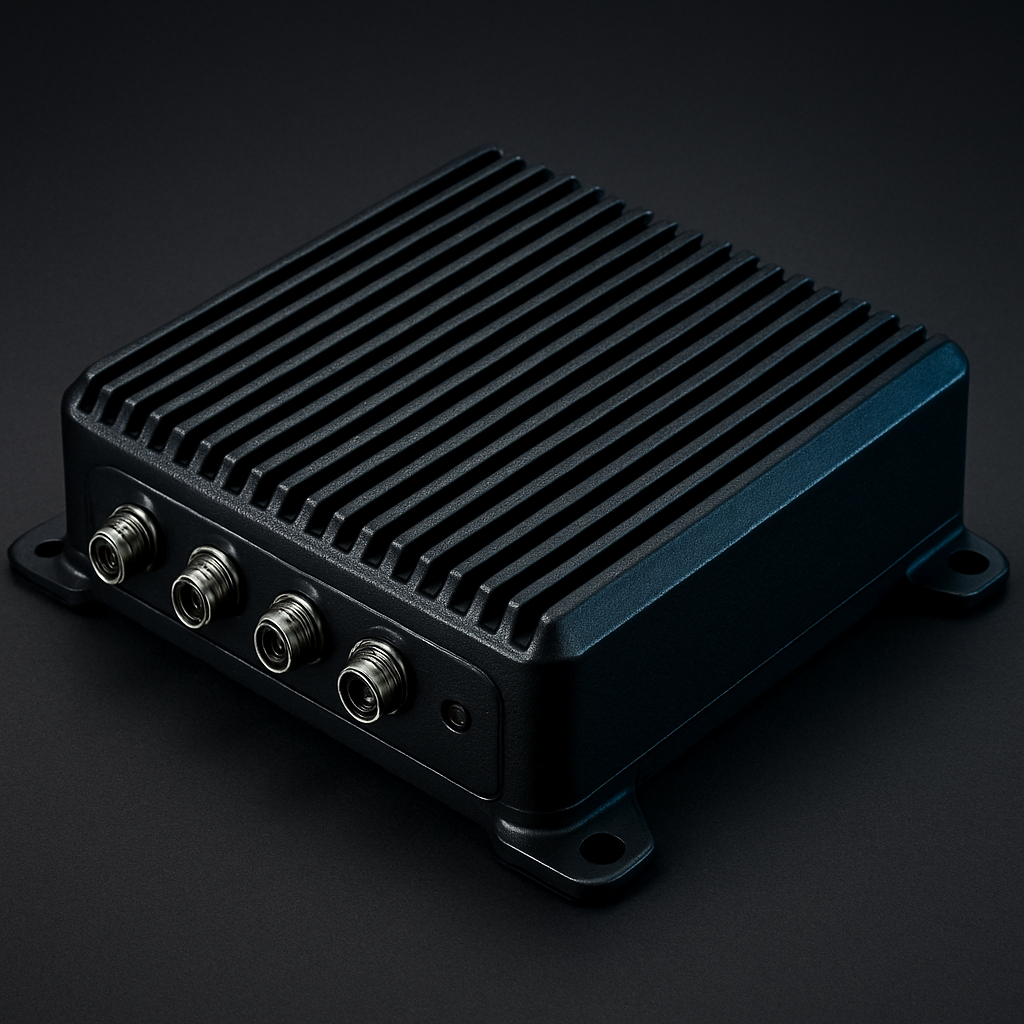
RobooPi P53
An NVIDIA Orin Nano 8 GB edge computer built around automotive camera links. Four Fakra ports take GMSL2 or FPD-Link modules over a single coax that carries video, control and power, all locked to one hardware clock — the box you put on a vehicle or a robot when four synchronised cameras have to be right.
5 in stock — ships now
- NVIDIA Orin Nano 8 GB — 40 TOPS (sparse), the full Jetson software ecosystem, CUDA and TensorRT
- 4 × Fakra camera inputs: MAX9296 (GMSL2) standard; MAX96792 (GMSL2/3) and DS90UB954 / DS90UB9702 (FPD-Link) optional
- MIPI D-PHY 4 lanes @ 2.5 Gbps per lane — four HD streams captured, not throttled
- Hardware frame sync across devices plus single-channel lock output for deterministic multi-camera timing
- 128 GB system storage + dual M.2 NVMe; with an SSD fitted, 2 channels of local recording at 1.2 GB/s
First 5 units ship from stock; beyond that, built to order in 30–60 days · 2-year warranty · Pairs with VisionLibra Data Services
Technical specs
| Basic | |
|---|---|
| Role | Multi-camera edge AI computer for vehicles, robots and industrial vision |
| Operating System | Ubuntu 20.04, NVIDIA Jetson software stack |
| Use Environment | In-vehicle, industrial, outdoor enclosure |
| Development | BSP updates, SerDes bring-up framework, sensor start-up framework, USB 2.0 debug port |
| Compute | |
| SoC | NVIDIA Orin Nano 8 GB |
| AI Performance | 40 TOPS (sparse) |
| Frameworks | CUDA, TensorRT and mainstream AI frameworks via the Jetson ecosystem |
| Camera Input | |
| Channels | 4 × Fakra camera modules, simultaneous |
| Deserialiser | MAX9296 (GMSL2) standard — MAX96792 (GMSL2/3), DS90UB954 / DS90UB9702 (FPD-Link) optional |
| Bandwidth | MIPI D-PHY, 4 lanes @ 2.5 Gbps per lane |
| Synchronisation | Hardware frame sync across devices; single-channel locked output |
| Sensor Control | I²C transparent transmission to the sensors |
| Camera Power | 12 V PoC over the coax — one cable per camera |
| Storage | |
| System | 128 GB |
| Expansion | 2 × M.2 NVMe slots |
| Local Recording | 2 channels @ 1.2 GB/s with optional SSD fitted |
| Interfaces | |
| Video Out | USB 3.0 (5 Gbps) Type-C — preview and streaming |
| Display | HDMI |
| USB | 2 × USB Type-A, 1 × Micro USB (debug) |
| Network | RJ-45 Ethernet |
| Expansion | Custom GPIO header; optional Wi-Fi and 4G modules |
| Electrical | |
| Power Input | USB Type-C PD 3.0, 20 V DC |
| PoC Output | 12 V to camera modules |
| Physical & Environmental | |
| Dimensions | ≤ 180 × 200 × 70 mm (L × W × H) |
| Cooling | Passive — finned die-cast chassis |
| Operating Temperature | 0 °C to 50 °C |
| Ingress Protection | IP40 |
| EMC | Industrial electromagnetic compatibility standards |
Built for
In-Vehicle Vision
Four automotive cameras on coax — the wiring cars and trucks already use.
Robot Perception
Orin Nano runs the same CUDA stack your models were trained against.
Industrial Inspection
Synchronised multi-angle capture with deterministic on-site latency.
Data Collection Fleets
Dual NVMe and 1.2 GB/s recording turn it into a mobile capture rig.
40 TOPS and four GMSL2 cameras in one rugged box
Capturing a dataset rather than building one device? Our data services team runs collection, annotation and evaluation on top of this hardware.